Commercial General Contractor Tampa Bay | MVH Construction
When the Client Is the County, There's No Room for Excuses — What That Means for Your Commercial Pro...
When the Client Is the County, There's No Room for Excuses — What That Means for Your Commercial Project
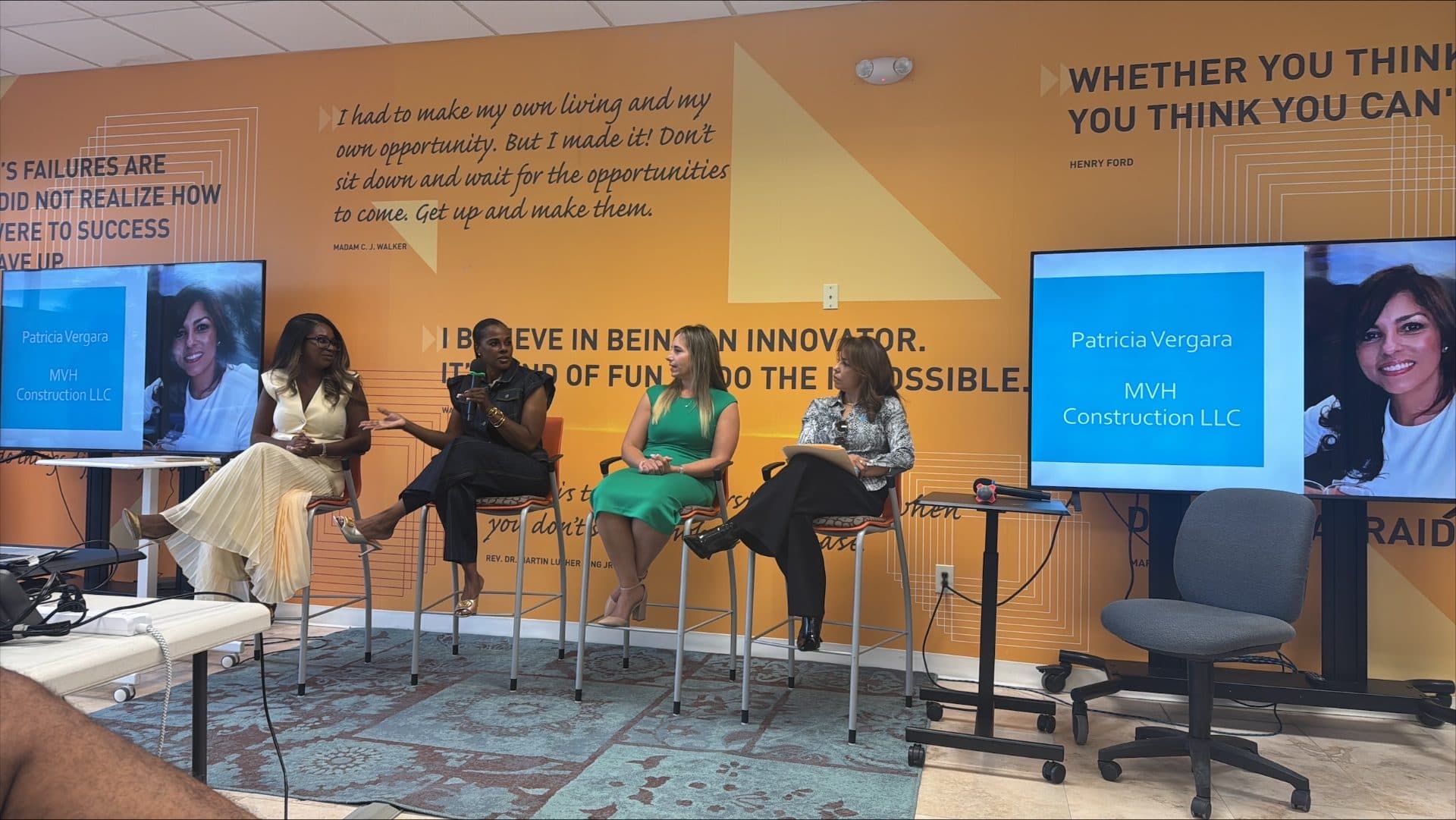
Last Friday, MVH Construction Vice President Patricia Vergara sat on a panel at the Entrepreneur Collaborative Center in Tampa, speaking to entrepreneurs looking to break into government contracting with Hillsborough County.
The advice she gave wasn't complicated. But it's hard to execute — and most contractors don't.
That gap is exactly why MVH has built the reputation we have as a commercial general contractor in the Tampa Bay area. And it's worth explaining publicly, because whether you're a county agency or a private developer, what you're really hiring when you hire a contractor is their operating standards. Those don't change based on who signs the contract.
What Government Work Actually Demands
Government construction projects are not forgiving. The paperwork is real. The oversight is real. The accountability is real. Schedules are tied to budget cycles, end-user agencies, and board approvals that exist completely outside a contractor's control.
Patricia's advice to the panel came down to three things:
Have your internal processes in place. Government work comes with bureaucracy by design. There are documentation requirements, compliance checkpoints, and layers of approval that don't exist on private jobs. Contractors who fight that process lose. Contractors who build internal systems to handle it — estimating, scheduling, change order management, reporting — are the ones who survive and get invited back.
Know your numbers. Know your costs. Know exactly what work you can deliver on. This sounds obvious. It isn't. Chasing contracts you're not equipped to execute is how small construction companies get hurt — and how they damage the clients who trusted them. Winning a bid means nothing if you can't perform.
Don't rely solely on government work. A healthy pipeline is a mixed pipeline. Government contracts provide stability and credibility. Private commercial work provides flexibility and speed. Operating across both — as MVH does — means the discipline each requires makes us better at the other.
What Executing for Hillsborough County Actually Looks Like
Principles are easy to say at a panel. Here's what they look like in the field.
MVH Construction is currently executing a renovation at the Pat Frank Court Building for Hillsborough County's Capital Programs Department — two judge's chambers, two courtrooms, a break room, and a jury room across 6,022 square feet of active judicial space inside a functioning government building. Active. Meaning other agencies are working in the building while we're constructing.
We are currently running four months ahead of schedule.
That cushion didn't happen by accident. And it wasn't protected by avoiding problems — it was protected by solving them fast, every time one appeared.
The Problems That Showed Up — and How We Handled Them
Night operations. Mid-project, the county determined that hanging drywall constituted noisy work that would disturb the other agencies occupying the building. That's not an unreasonable call — but it required us to shift a significant portion of our operations to nighttime hours, quickly, without losing schedule momentum. We adapted. Work continued. The other agencies weren't disrupted. This is what it looks like when a contractor has the staffing depth and scheduling flexibility to absorb a change like that without turning it into a crisis.
County procedures for sensitive systems. Work on the sprinkler and alarm systems came with its own layer of county-specific procedures — requirements that go well beyond standard commercial protocol. A portion of that work also had to be performed at night to comply. Knowing those requirements ahead of time and coordinating our subcontractors around them is the difference between a smooth project and a shutdown.
Material logistics in an occupied building. Every piece of material entering that job site had to be carried approximately 150 feet through an active building without disturbing the occupying agencies. That's not a construction problem — it's a logistics and communication problem. We planned for it, coordinated with the county, and executed it without incident.
Unforeseen existing conditions. When construction uncovered conditions not reflected in the original design documents, we didn't default to a change order that maximized margin and pushed the timeline. We worked directly with the county's design team and our subcontractors to develop value-engineering options — solutions that minimized both cost and schedule impacts to the county.
The result: because we were four months ahead when the county identified additional scope with long lead items, we were able to absorb that work and still deliver on time to the end-user agency. That's what schedule discipline earns you.
What This Means If You're a Commercial Developer or Property Owner
Government construction is the hardest operating environment in this industry. More oversight, more stakeholders, stricter compliance, longer approval chains, and an occupied building that can't be disrupted while you work.
If MVH is running four months ahead of schedule under those conditions — adapting to night shifts on short notice, navigating county-specific system procedures, managing material logistics in an active courthouse, and value-engineering unforeseen conditions without blowing the budget — the question worth asking is: what does that look like on your commercial project?
Private construction is faster, more flexible, and free of most of the administrative overhead that government work requires. The same systems that keep us ahead of schedule for the county — our scheduling discipline, cost controls, subcontractor coordination, and ability to solve problems without escalating them into budget crises — apply directly to your ground-up shell, tenant buildout, or commercial renovation.
The red tape doesn't exist on your job. Our standards still do.
Why Patricia Was on That Panel
MVH shared that experience at the Entrepreneur Collaborative Center because 15 years of building as developers — with our own capital at risk — and years operating as a licensed general contractor in Florida give us something worth passing on: hard-earned experience with real consequences.
The contractors who do well in this industry are the ones who build systems, know their numbers, and protect their clients' projects like they're their own. That's how MVH operates. Every project, every client, every time.
MVH Construction LLC is a certified MBE, DBE, DM-DWBE, and SBE commercial general contractor serving the Tampa Bay area. For commercial shell construction, tenant buildouts, and government renovation projects, contact us at 813-374-3252
Related Articles
 Read More
Commercial Construction Company Tampa
Commercial Construction Company In Tampa: MVH Construction Key Takeaways MVH Construction is a comme...
 Read More
Hillsborough County Commercial Contractor
Hillsborough County Commercial Contractor - MVH ConstructionIf you're planning a commercial build-ou...
 Read More
Office Renovation Contractor Tampa | MVH Construction
Office Renovation Contractor In TampaIf your Tampa office space feels stuck in the past, you are not...